Goth AI Math: What It Is, How It Works, and Where to Try It Free

Goth AI Math: How It Works & Where to Try It Free Curious about Goth AI math? Learn what it actually does, how it handles math problems, and where you can access Goth AI free, including tools worth trying today. This article breaks down what Goth AI is, how its math capabilities work, and what makes it different from mainstream AI tools. It also covers where to try Goth AI for free and whether it’s worth your time if you’re a curious user, comparing options, or ready to explore. Most AI tools look the same. Clean whites, cheerful gradients, and a tone that sounds like it was designed in a corporate focus group. Goth AI is not that. Whether you stumbled across the term “Goth AI math” in a thread, a TikTok comment, or a deep corner of the internet, you’re probably wondering: Is this a real tool? Does it actually solve math problems? And can you use Goth AI for free without signing up? The short answer: yes, yes, and yes with some nuance worth knowing. This guide covers what Goth AI actually is, how its math features work, what kinds of problems it handles, and where to access it for free. No hype. No padding. Just what you need to know. What Is Goth AI? Goth AI is an AI-powered assistant built around an aesthetic identity, dark, sharp, and stylistically distinct from the pastel-and-bubbly AI landscape. It’s not a gimmick. The “goth” framing is a design and branding choice that shapes how the tool presents itself: no forced positivity, no hollow encouragement, just direct and useful output. Under the hood, Goth AI uses large language model (LLM) technology, the same foundational architecture behind most modern AI assistants. What sets it apart is the personality layer: its responses tend to be more matter-of-fact, tonally dark, and less likely to over-explain or add unnecessary filler. For users who find mainstream AI tools exhausting in their cheerfulness, this is a meaningful difference. How Goth AI Math Actually Works Math is one of Goth AI’s more functional use cases, and understanding why it helps you use it better. Like most LLM-based tools, Goth AI handles math through a combination of pattern recognition and reasoning. It can: Where it gets more nuanced: AI math tools, including Goth AI, can make calculation errors on complex or multi-layered problems. This is a known limitation across the board. For high-stakes problems, exam prep, engineering work, and financial modelling, always verify with a dedicated math solver or a second source. That said, for conceptual understanding, homework help, and working through logic step by step, GoThi AI math performs well. What Makes Goth AI Different From Other AI Tools? The aesthetic is obvious. But the functional differences matter more. Tone without fluff. Many AI assistants over-explain, add disclaimers to everything, and wrap answers in layers of hedging. Goth AI tends to cut that. If you ask it to solve something, it solves it without apologising for existing. Personality consistency. The dark aesthetic isn’t just a skin. The tool maintains a consistent voice that doesn’t randomly switch into corporate-speak. For users who interact with AI frequently, that consistency is actually useful. Lower friction for direct questions. Because Goth AI doesn’t pad its responses with enthusiasm and caveats, getting a useful answer often takes fewer exchanges. Creative range. While math is a strong use case, Goth AI handles writing, ideation, character development, and dark-themed creative content in ways that mainstream tools sometimes resist or soften. Where to Try Goth AI Free This is probably what you’re really here for. Several platforms now offer Goth AI or Goth AI-adjacent experiences and tools with dark aesthetic identities and capable underlying models. The freemium model is common: a free tier with usage limits and a paid tier for heavier use. When looking for Goth AI free access, the things to look for are the following: One platform worth exploring in this space is Madeonverse, which brings AI-powered creative tools with a darker, more expressive aesthetic direction. If you’re searching for Goth AI alternatives with serious functionality and a personality that doesn’t feel mass-produced, it’s a strong starting point. Before committing to any paid plan, always test the free tier. Most tools give you enough access to know whether the tool fits how you think and work. Goth AI for Math: Best Use Cases Here’s where Goth AI math genuinely earns its place: Homework and study help. Walking through a problem, explaining where a mistake was made, or rephrasing a concept in a different way — this is where AI math tools shine. Goth AI adds the benefit of not being patronizing about it. Concept explanation. “Explain integration by parts like I’m not an idiot” is a prompt that works well with a tool that doesn’t over-soften its communication style. Quick calculations and conversions. Unit conversions, percentages, ratios — the kind of fast math that doesn’t require a full calculator app but isn’t worth doing by hand. Checking logic in word problems. Paste a problem and your attempted solution. Ask Goth AI to find the flaw. This works surprisingly well. Writing math into creative or narrative contexts. If you’re writing fiction that includes technical elements, or need to explain a mathematical idea to a non-technical audience, Goth AI handles the translation well. Limitations Worth Knowing No tool is complete without its caveats. Precision on complex calculations. AI tools can hallucinate numbers — producing confident-sounding wrong answers on multi-step numerical problems. Always verify anything important. Advanced symbolic math. For serious symbolic computation (heavy calculus, differential equations, proofs), a dedicated tool like Wolfram Alpha is more reliable. Goth AI is better positioned as a reasoning and explanation layer, not a pure computation engine. Context window limits. If you’re working through a long problem and the conversation gets extended, earlier context can drop off. Keep sessions focused. Availability of free tiers. Free access is real, but usage caps mean heavy users will eventually hit a wall.
AI Transformation Is a Problem of Governance: The Definitive Strategic Guide (2026)

Executive Summary As enterprises race to integrate Artificial Intelligence, a stark reality has emerged: over 70% of AI initiatives fail to scale. Contrary to popular belief, these failures are rarely due to technical limitations or a lack of data. Instead, they stem from a “Governance Gap.” The truth is that ai transformation is a problem of governance, not just a technological hurdle.This fundamental shift in perspective reveals that without a robust oversight and leadership framework, even the most advanced models become liabilities. This guide explores why ai transformation is a problem of governance and provides a multi-layered framework for sustainable, value-driven AI adoption.As enterprises race to integrate Artificial Intelligence, a stark reality has emerged: over 70% of AI initiatives fail to scale. Contrary to popular belief, these failures are rarely due to technical limitations or a lack of data. Instead, they stem from a “Governance Gap.” This guide explores why AI transformation is fundamentally a leadership and oversight challenge and provides a multi-layered framework for sustainable, value-driven AI adoption. 1. The AI Paradox: Speed Without Direction The current corporate landscape is characterized by a frantic “AI Gold Rush.” Organizations are pouring billions into Large Language Models (LLMs), predictive analytics, and autonomous agents. However, without a steering mechanism, this speed often leads to “Pilot Inflation”—a state where dozens of AI experiments are running in silos, but none provide measurable ROI or enterprise-wide transformation. The Governance Thesis: Technology enables AI, but governance makes it trustworthy, scalable, and strategically aligned. 2. Why Traditional IT Governance Fails AI Traditional software governance relies on deterministic outcomes (input A always leads to output B). AI, however, is probabilistic and dynamic. Feature Traditional Software AI Systems Behavior Static and predictable Learning and evolving Logic Rule-based (Transparent) Neural networks (Black Box) Risk Profile Security & Uptime Bias, Hallucinations, & Ethical Drift Oversight Periodic audits Continuous monitoring Because AI models “drift” as they consume new data, a “set-it-and-forget-it” approach is a recipe for disaster. 3. The Four Pillars of Strategic AI Governance To solve the transformation problem, organizations must move beyond compliance and treat governance as an operational “Skeleton.” Pillar 1: Board-Level Accountability (The Brain) Insights from Supaboard and Forbes indicate that AI is no longer just a “CIO issue.” It is a fiduciary responsibility. Pillar 2: Technical & Data Integrity (The Fuel) According to CIO.com, poor data governance is the primary killer of AI projects. Pillar 3: Risk, Ethics, and Compliance (The Guardrails) With the EU AI Act (2026) and OECD guidelines now in full force, legal risk is at an all-time high. Pillar 4: Change Management & Human Oversight (The Soul) AI transformation is as much about people as it is about code. 4. The High Cost of Governance Failure: Case Studies Jade Global highlights that ungoverned AI is a liability, not an asset. 5. The BRM Framework: Moving from AI Velocity to Strategic Value Benefits Realization Management (BRM) is the missing piece in the AI puzzle. 6. Operationalising Governance: A 5-Step Roadmap For organisations looking to fix their AI transformation, follow this path: 7. Conclusion: Governance is Your Competitive Edge AI Transformation succeeds when organisations treat governance as infrastructure, not an afterthought. In the 2026 landscape, the leaders will not be those with the fastest algorithms, but those with the most robust, transparent, and accountable frameworks. Governance does not slow innovation; it provides the “brakes” that let you drive the “AI race car” faster and with greater confidence.
Virtual Escape Room: The Ultimate Guide to Online Puzzle Adventures

Whether you are a remote team looking for a fun bonding activity, a teacher designing an interactive lesson, or simply someone craving a brain-teasing challenge from home, the virtual escape room has become one of the most engaging digital experiences of the decade. This comprehensive guide walks you through everything from what virtual escape rooms actually are to the best free and paid options available to tips that help your team escape every time. What Is a Virtual Escape Room? A virtual escape room is an online adaptation of the popular physical escape room concept. Players work together or alone to solve a series of interconnected puzzles, riddles, and challenges within a set time limit, all delivered through a digital interface. Unlike a physical escape room where you are literally locked in a themed space, the virtual version runs entirely through a browser, a video call, or a dedicated platform. The goal remains identical: gather clues, decipher codes, unlock hidden compartments, and ultimately “escape” before the timer runs out. What makes the virtual format uniquely powerful is its accessibility; participants can join from anywhere in the world, making it ideal for distributed teams, long-distance friend groups, or classrooms with remote students. Why Virtual Escape Rooms Work Research in team psychology consistently shows that shared problem-solving under mild time pressure builds trust and communication faster than passive social activities. Virtual escape rooms replicate this dynamic entirely online — no physical space required. Are Virtual Escape Rooms Fun to Play with Your Team? Absolutely, and the data backs this up. Virtual escape rooms have surged in popularity since 2020, with corporate teams, schools, and social groups adopting them as a staple activity. Here is why they work so well as a group format: The built-in social layer is what elevates virtual escape rooms above standard online games. Many platforms now include integrated video chat, live leaderboards, and team-based scoring systems that transform a simple puzzle game into a full shared experience. 15 Best Free Online Escape Rooms 1. Hogwarts Digital Escape Room Created by a librarian and built around J.K. Rowling’s wizarding world, this Google Forms-based escape room is one of the most widely shared free experiences online. Players navigate puzzles tied to Hogwarts houses, spells, and magical lore. It requires no downloads and works seamlessly in any browser, making it perfect for classrooms and Harry Potter fan groups alike. 2. Romeo and Juliet Escape Room This literary-themed escape room is designed around Shakespeare’s most famous tragedy. Teachers have used it extensively as an educational supplement — students must demonstrate knowledge of the play’s plot, characters, and themes to progress through each puzzle stage. It is an excellent example of how virtual escape rooms can double as curriculum-aligned learning tools. 3. Escape Minecraft Designed for Minecraft enthusiasts, this escape room blends the iconic block-building game’s visual language with traditional escape room puzzle mechanics. Players must solve riddles tied to Minecraft crafting recipes, biomes, and game lore. It is particularly popular with younger audiences and gaming communities. 4. Oregon Trail Escape to Willamette Valley Built around the beloved Oregon Trail educational game, this free escape room challenges players with geography, history, and survival decision-making. It captures the spirit of the original game while layering in escape room mechanics — making it one of the most nostalgic free options available for players aged 25 and above. 5. The Assassination of Abraham Lincoln A history-focused escape room that plunges players into the events surrounding one of America’s most significant historical moments. This puzzle experience requires players to decode historical documents, maps, and timelines. Educators have praised it as an immersive alternative to traditional history lessons. 6. Mr-X Mr-X is a browser-based treasure hunt where players follow cryptic clues across multiple online destinations — including real websites, search engines, and hidden pages. It is one of the more technically adventurous free escape rooms, appealing to players who enjoy a multi-platform challenge that blurs the line between puzzle game and real-world internet exploration. 7. Shelburne Museum Escape Rooms Created by the Shelburne Museum in Vermont, these escape rooms are built around the museum’s actual art and artifact collections. They offer a genuinely educational experience, with puzzles designed to teach players about folk art, American history, and museum curation — all while racing the clock. 8. Oscar’s Stolen Oscar A lighthearted, film-themed escape room where players must track down a stolen Academy Award. This experience strikes an ideal balance between accessible puzzles and witty storytelling, making it a popular choice for casual friend groups and office teams who want fun without excessive complexity. 9. The Midnight Express Set aboard a fictional train speeding through the night, The Midnight Express is a narrative-rich escape room with atmospheric puzzle design. Players must investigate a mystery unfolding in real time as the journey progresses. Its strong storytelling foundation makes it stand out in a crowded field of browser-based escape rooms. 10. See Me Escape Room See Me Escape Rooms are designed with inclusivity in mind — particularly for players with visual or cognitive accessibility needs. They are available free of charge and have been adopted by disability advocacy organizations as an example of how digital entertainment can be thoughtfully designed for all audiences. 11. Enchambered: Alone Together 14. Escape From Wonderland Inspired by Lewis Carroll’s Alice in Wonderland, this visually inventive escape room leans heavily on lateral thinking and wordplay. Puzzles are deliberately nonsensical in keeping with the source material’s spirit — which makes it a uniquely satisfying experience for players who approach problems creatively rather than analytically. 15. Ultra Mega Super Death Do not let the dramatic name fool you — Ultra Mega Super Death is a community-created escape room designed for experienced players who have outgrown beginner difficulty. Its puzzles are deliberately obscure, multi-layered, and occasionally brutal in their complexity. For escape room veterans looking for a genuine challenge, this free experience is a must-play. Free Virtual Escape Rooms for Teams: Key Differences While the 15 rooms listed
EU AI Act News Today 2026: Council Agrees Position to Streamline Rules on Artificial Intelligence

In a pivotal moment for global technology governance, the European Union’s Council has officially agreed on its position to streamline the rules governing artificial intelligence (AI). This development, forming part of the so-called “Omnibus VII” legislative package, signals a major shift in how AI will be regulated across the EU, and its ripple effects are being felt far beyond European borders, including in the United States. For American businesses, tech companies, investors, and policy analysts tracking eu ai act news today 2026, understanding these regulatory changes is no longer optional. As the EU tightens its AI governance framework, American companies operating in or exporting to EU markets must navigate a rapidly evolving compliance landscape. This comprehensive guide breaks down everything you need to know about the latest EU AI Act implementation news, the Council’s key amendments, what changed from the original proposal, and — critically — what it all means for you. What Is the EU AI Act? A Quick Recap for U.S. Readers Before diving into the latest eu ai act implementation news today, it is important to understand the foundational context. The EU Artificial Intelligence Act is the world’s first comprehensive legal framework specifically designed to regulate AI. Adopted on May 21, 2024, it entered into force on August 1, 2024. The AI Act classifies AI systems into four risk categories: Penalties for non-compliance are steep: up to €35 million or 7% of worldwide annual turnover for prohibited practice violations, and up to €15 million or 3% for other infringements. For American companies with EU operations, these are numbers that demand serious attention. EU AI Act News Today: The Council’s Latest Position Explained The most significant eu ai act news today centers around the Council of the EU agreeing on its formal negotiating position on the “Omnibus VII” streamlining proposal — a package designed to simplify and improve the practical application of the AI Act. Marilena Raouna, Deputy Minister for European Affairs of the Republic of Cyprus and current Council Presidency holder, emphasized the urgency of this work: the goal is to provide greater legal certainty, make rules more proportionate, and ensure harmonized implementation across all EU member states. Key Proposals from the European Commission The European Commission’s original proposal within the Omnibus VII package included several targeted changes to the AI Act: Major Amendments Introduced by the Council While broadly maintaining the Commission’s proposed direction, the Council’s mandate introduces several important and noteworthy modifications. These represent the areas where member states pushed back or strengthened the original text. 1. New Prohibition on Non-Consensual Sexual Content and CSAM One of the most socially significant additions in the Council’s mandate is a brand-new provision explicitly prohibiting AI practices that generate non-consensual sexual and intimate content, as well as child sexual abuse material (CSAM). This is a direct response to growing public concern over deepfake pornography and AI-generated abuse material. For U.S. tech companies developing generative AI products, this creates an important red line for EU market access. 2. Fixed Timelines for High-Risk AI Rule Application Rather than leaving the timeline flexible (as the Commission proposed), the Council has established fixed dates: This is a meaningful shift from the Commission’s “standards-ready” trigger approach. The fixed deadlines give businesses more predictability but also mean there is no possibility of further delay if standards are not finalized in time. 3. Reinstated Database Registration Obligation The Council mandate reinstates an important transparency mechanism: providers of AI systems who believe their system is exempt from high-risk classification are still required to register those systems in the EU AI database. This “presumed exempt but registered” approach maintains oversight even where companies self-assess their systems as lower risk. 4. Stricter Standard for Sensitive Data Processing The Council reinstated a higher standard for processing sensitive categories of personal data (such as racial or ethnic origin, health data, or political opinions) when used for bias detection and correction. The standard of “strict necessity” means companies cannot process such data speculatively — it must be demonstrably needed to identify and fix algorithmic bias. 5. Delayed AI Regulatory Sandboxes Deadline The Council postponed the deadline for EU member states to establish national AI regulatory sandboxes — controlled environments for testing AI systems under regulatory supervision — to December 2, 2027. This delay reflects the practical challenges many member states face in building the necessary regulatory infrastructure. 6. Clarified AI Office Supervision Powers The mandate clarifies the division of enforcement responsibilities between the EU’s central AI Office and national authorities. Specifically, the AI Office has oversight for general-purpose AI (GPAI) models — but national authorities remain the competent bodies for specific sensitive sectors, including law enforcement, border management, judicial authorities, and financial institutions. This carve-out for national jurisdiction is significant for both privacy and accountability reasons. AI Regulation Updates: The Complete Implementation Timeline One of the most-searched topics in ai regulation updates is the implementation timeline. Here is a complete picture of where things stand as of early 2026: Note: These timelines are subject to final agreement through the ongoing “trilogue” negotiations between the Council, the European Parliament, and the European Commission. The Parliament’s aim is to begin these talks in April or May 2026. AI Safety Policy News Today: What the U.S. Should Be Watching From an ai safety policy news today perspective, the EU’s moves carry enormous geopolitical and commercial significance for the United States. Here is why American stakeholders cannot afford to ignore these developments: The Brussels Effect The EU’s regulatory standards often become de facto global standards — a phenomenon known as the “Brussels Effect.” Because major U.S. corporations such as Google, Meta, Microsoft, and Amazon are deeply embedded in EU markets, they must comply with the AI Act. Once compliance infrastructure is in place for the EU, companies often apply similar standards globally to improve efficiency. This means the EU AI Act could end up shaping AI governance in U.S. operations even without American legislation requiring it. Divergence from the U.S. Approach While the EU
Madonverse vs. Bigscreen: Which Platform Delivers the Best VR Movie Experience in 2026?
Complete Entertainment Comparison | Social VR Cinema | Watch Movies in Virtual Reality The Way We Watch Movies Is Changing Forever Think about the last time you watched a movie alone on a laptop, wishing your friends who live across the country could be sitting right next to you. Or the last time you paid for a cinema ticket, only to sit in front of a screen that honestly didn’t feel much bigger than your TV at home. That frustration is exactly why social VR movie watching is growing at an extraordinary pace. In 2024, over 47 million users engaged with VR-based movie experiences globally, and VR cinema halls expanded to 280 locations mostly across the Asia-Pacific region. Linezero Meanwhile, 42% of VR device owners have already used their headset to watch films or TV, Jatinder Palaha making entertainment the second-largest use case for VR hardware after gaming. Two platforms are at the centre of this shift for different reasons: Bigscreen, the dedicated social VR cinema app built entirely around the movie-watching experience, and Madonverse, the blockchain-powered metaverse entering the entertainment space with a Web3-native angle. This is the most complete comparison of both platforms for anyone trying to decide where to spend their evenings in 2025. Why VR Movie Watching Is the Future of Entertainment Before diving into the platforms, it helps to understand why this market matters right now. The global movies and entertainment market is projected to expand to over $200 billion by 2033, driven by increasing digital consumption, streaming adoption, and technological advancements that optimize viewer experiences across multiple platforms. Meetaverse But the real growth is happening in immersive formats. The integration of virtual reality, augmented reality, and interactive elements is becoming a significant trend in the entertainment industry — providing audiences with immersive and engaging environments that streaming alone cannot replicate. Technologymagazine The numbers back this up. VR movies saw 20% growth in user engagement with over 6 million active global users Meetaverse — and that number has been climbing consistently. The question is no longer whether VR cinema will go mainstream. It is which platforms will own that experience when it does. Bigscreen: The Original Home of Social VR Cinema Bigscreen was born specifically for one purpose — letting people watch content together in virtual reality. Since its launch in 2016 on Steam, it has become the most recognized name in social VR movie watching. What Bigscreen Actually Offers Bigscreen VR is an immersive platform that allows users to watch films in a fully immersive and interactive environment. With just a VR headset and a compatible device, users can enter virtual cinemas where they can enjoy movies in a way that transcends the boundaries of traditional theaters. ArborXR The core feature set in 2025 is extensive: Virtual Cinema Environments: Bigscreen VR offers a range of immersive virtual cinemas that transport users into completely different worlds of film watching — from a classic theater with red velvet seats and grand chandeliers to a futuristic space station theater with panoramic views. ArborXR Social Viewing: Users can invite friends or join public screenings to watch films together regardless of physical distance, communicating through voice chat that creates a genuine sense of presence and camaraderie. ArborXR Content Access: You can watch YouTube videos, browse Amazon Prime or Disney+, catch Twitch streams, or access free ad-supported TV content — all while hanging out with friends in VR. ENGAGE The platform also includes free movies via PlutoTV integration and supports local file playback in MP4, MKV, and AVI formats including 3D side-by-side and over-under formats. Remote Desktop Streaming: The revolutionary Remote Desktop feature allows you to project your entire PC screen into your VR headset, creating a giant virtual screen several meters wide — essentially turning any streaming service you subscribe to into a VR cinema experience. Luminous XR Technical Specs in 2025: Bigscreen now has over 15 million active users worldwide and has evolved with support for Meta Quest 3S, Apple Vision Pro, and the latest Wi-Fi 7 optimizations. ENGAGE Compatible hardware includes Meta Quest 2/3/3S/Pro, Pico 4, Apple Vision Pro, Valve Index, HTC Vive, and all PCVR headsets via SteamVR. Customization: Users can adjust the size and curvature of the screen — whether you prefer a gigantic IMAX-like screen or a cozy home theater setup — and the platform incorporates spatial audio to simulate a three-dimensional soundscape that makes you feel genuinely present in the cinema. ArborXR The Honest Reality About Bigscreen Right Now Here is something most comparison articles won’t tell you: Bigscreen is at a complicated moment. Bigscreen has long been lauded for its shared virtual theaters, but now suffers from stagnant growth and developer inactivity. The roadmap for Bigscreen Beta appears nonexistent — the most recent app-related blog post found was from June 2024. ENGAGE The user numbers reflect this: VRChat recently achieved an all-time peak concurrent user count of 79,583 on Steam, while Bigscreen’s peak came in 2021 with 315. Today, 24-hour peaks are lucky to hit 100. ENGAGE Bigscreen no longer allows direct movie rentals within the app as of March 2025 due to platform policy restrictions ENGAGE — a meaningful loss for users who relied on that feature. The company has shifted much of its energy toward its hardware business — the Bigscreen Beyond headsets — which are genuinely impressive: the Beyond 2 delivers edge-to-edge clarity, a huge sweet spot, less glare, and a massive 116-degree diagonal field of view, with specifications that compete with or even beat the Meta Quest 3 and Apple Vision Pro. Luminous XR Madonverse: The Web3 Metaverse Entering Entertainment Madonverse is a blockchain-powered metaverse platform built on Ethereum and Polygon. While originally positioned around virtual land ownership and Web3 gaming, its social environments, avatar-based interaction, and virtual event infrastructure make it an increasingly relevant player in the entertainment metaverse space. What Madonverse Offers Entertainment-Focused Users Where Madonverse Stands in Entertainment Madonverse’s entertainment angle is about the social experience around content — the gathering, the event, the
Madonverse vs ENGAGE XR: Best Platform for Corporate VR Meetings & Employee Training in 2025?
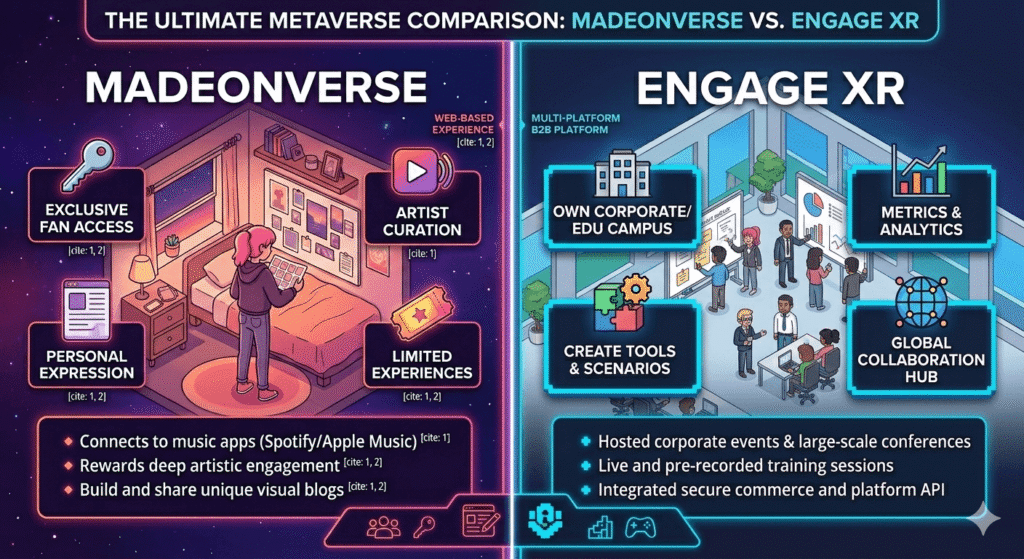
A Complete B2B Comparison | Enterprise Metaverse | Immersive Learning | Virtual Reality Workplace Why Your Business Needs to Choose the Right VR Platform Right Now The corporate world is in the middle of a quiet revolution. Flat video calls are losing ground to something far more powerful — immersive, avatar-based virtual reality collaboration that actually replicates the feeling of being in the same room. The global VR training market, valued at over $9 trillion in 2023, is projected to reach $298 billion by 2033, growing at a CAGR of 41.8%. Blockchainappsdeveloper This is no longer a trend for tech companies to explore. It is a business decision that HR directors, L&D managers, and IT procurement heads are actively making right now. Two platforms dominating B2B conversations in this space are Madonverse — a blockchain-powered metaverse entering the enterprise space — and ENGAGE XR — a purpose-built, London Stock Exchange-listed corporate VR platform trusted by over 200 organizations globally. This deep-dive comparison gives you everything you need to make the right call for your organization. ENGAGE XR: The Established Enterprise VR Powerhouse Previously known as “Immersive VR Education,” ENGAGE XR is a Europe-based company listed on the London Stock Exchange. Meetaverse It has spent over six years building a platform laser-focused on enterprise and professional use — and the results speak for themselves. What ENGAGE XR Actually Does for Businesses ENGAGE XR’s enterprise solutions excel in enhancing remote collaboration, making geographical boundaries irrelevant. Teams can meet in fully interactive virtual environments that replicate real-world meeting rooms or create custom-designed spaces for innovation and creativity, with VR and AR-powered sessions offering real-time collaboration, brainstorming, and problem-solving far beyond traditional video conferencing. Cognitive3d Key enterprise capabilities include: Real-World Enterprise Case Studies ENGAGE XR’s credibility is not theoretical. Its client roster includes some of the world’s most recognizable brands and institutions. KIA Digital Twin: KIA partnered with ENGAGE to build an exact replica of their car sales showroom, used globally for marketing events and sales training, populated by remote sales teams with digital twins of KIA’s new EV6 and EV9 motorcar ranges. VR/AR Association ExxonMobil: ExxonMobil worked with ENGAGE on a recreation of their head office in Houston, Texas. The digital twin is extensively used for onboarding new employees, providing virtual campus tours and showing key locations in case of emergency. VR/AR Association Stanford University & Kansas University School of Nursing: Medical students received classes remotely inside ENGAGE and interacted with multiple human anatomy models — dramatically reducing the cost of training with expensive physical equipment. ENGAGE Interpol Europe: ENGAGE built a replica of Interpol Europe’s HQ in France for events, training, studies, and social gatherings. ArborXR Madonverse: The Web3 Metaverse Entering Enterprise Territory Madonverse is a blockchain-powered metaverse platform built on Ethereum and Polygon. Originally positioned around virtual land ownership and Web3 gaming, it has been expanding toward enterprise collaboration and virtual events — making it a relevant player in conversations about the corporate metaverse. What Madonverse Offers Businesses Where Madonverse Fits in B2B Madonverse is best understood as a Web3 enterprise collaboration tool rather than a dedicated corporate VR training platform. For organizations building a metaverse brand presence, experimenting with blockchain-based virtual spaces, or hosting immersive virtual events, it offers a compelling and affordable entry point. LSI Signal: The enterprise metaverse is distinct from the consumer metaverse. The enterprise metaverse focuses on being productive, working together, and integrating business processes — as opposed to entertainment and social interaction. ENGAGE Madonverse bridges both worlds; ENGAGE XR operates firmly within the enterprise definition. Head-to-Head: Feature Comparison for B2B Buyers Feature Madonverse ENGAGE XR Primary B2B Use Case Virtual events, brand metaverse VR training, meetings, digital twins Enterprise Security Emerging ISO 27001, GDPR, SSO, 2FA, Gov Cloud Blockchain / Web3 Yes (Ethereum/Polygon) No VR Headset Support Limited Full (Meta Quest, HTC Vive, Pico, Lenovo VRX) Digital Twins No Yes — KIA, ExxonMobil, Interpol Training Modules Basic Comprehensive + simulation AI Integration Basic Generative AI, AI Character Builder LMS Integration No Yes Max Room Capacity Variable 70 per room / tens of thousands via events Pricing Model Token-based + subscription Enterprise licensing (custom) Mobile Access Yes Yes (limited) Founded 2022 2018 Stock Exchange Listed No London Stock Exchange (AIM) Trusted Organizations Emerging 200+ globally Corporate VR Meetings: Which Platform Actually Works? ENGAGE XR for Corporate Meetings ENGAGE XR does not simply replicate a Zoom call in 3D. It fundamentally changes how distributed teams interact. ENGAGE provides tools for collaboration including immersive whiteboards, screen streaming, 3D virtual pens, and spatial VoIP communications to enable more natural interaction at distance. Meetaverse Meeting environments range from branded virtual boardrooms and conference centers to open creative spaces and custom replicas of real-world offices. For multinational teams running complex collaborative sessions, this is the platform that removes the limitations of geography without sacrificing the richness of in-person interaction. ENGAGE XR also recently launched ENGAGE 4.0, positioning itself as the ultimate interactive whiteboard replacement for reimagining remote collaboration. Educators in VR Madonverse for Corporate Meetings Madonverse delivers a solid metaverse-style meeting experience for teams comfortable with avatar-based interaction. Its mobile accessibility and Web3 integration make it particularly appealing for tech companies, crypto-native organizations, and startups that want a meeting environment that reflects their brand identity and forward-thinking culture. For structured, compliance-sensitive, or highly technical collaborative sessions requiring enterprise-grade tooling, Madonverse is still maturing. Companies with strict IT security requirements will need to evaluate its enterprise credentials carefully before deployment. Meeting Verdict: ENGAGE XR for enterprise reliability; Madonverse for Web3-forward teams seeking a fresh, accessible collaboration experience. VR Corporate Training: Where the Real B2B Value Lives This is the single most important differentiator between these two platforms for most B2B buyers. The Data Case for VR Training in 2025 The ROI evidence for immersive VR training is now well-established across industries: ENGAGE XR’s Training Infrastructure Organizations can use ENGAGE XR to ease employees and students into new skills and processes — from working with expensive robotic mannequins to driving forklifts —
Madonverse vs The Sandbox:
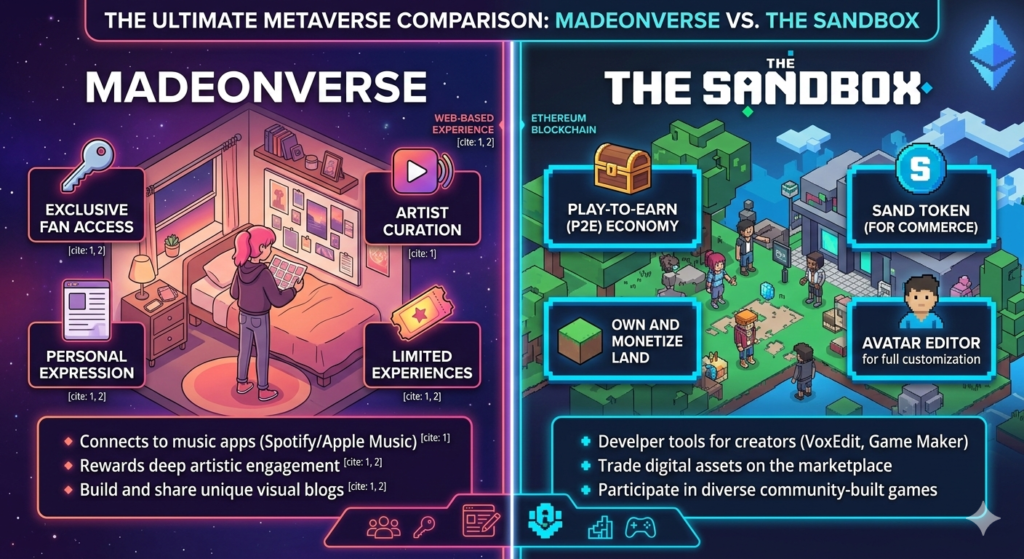
Which Web3 Gaming & Virtual Land Platform Is Worth Your Investment? Introduction: The Rise of Web3 Gaming and the Metaverse Economy The metaverse is no longer a sci-fi concept; it is a rapidly expanding digital economy powered by blockchain technology. Platforms like Madonverse and The Sandbox have redefined how we think about virtual land ownership, play-to-earn gaming, and decentralised virtual worlds. Whether you are a Web3 gamer, a virtual real estate investor, or simply someone exploring the best metaverse platform in 2024, this in-depth comparison will help you make an informed decision. Part 1: Understanding Both Platforms What Is Madonverse? Madonverse is an emerging Web3 metaverse platform built on blockchain infrastructure, designed to make decentralized virtual worlds accessible to mainstream users. It offers a social and gaming-focused environment where users can: Madonverse specifically targets users who are new to the Web3 ecosystem, providing a lower barrier to entry compared to more established platforms. Its mobile-first approach also sets it apart in the blockchain metaverse space. Part 1: Understanding Both Platforms What Is Madonverse? Madonverse is an emerging Web3 metaverse platform built on blockchain infrastructure, designed to make decentralised virtual worlds accessible to mainstream users. It offers a social and gaming-focused environment where users can: Madonverse specifically targets users new to the Web3 ecosystem, offering a lower barrier to entry than more established platforms. Its mobile-first approach also sets it apart in the blockchain metaverse space. Part 2: Head-to-Head Feature Comparison The table below provides a direct comparison of the core features of both platforms: Feature Madonverse The Sandbox Launch Year 2022 2021 (Alpha) Blockchain Ethereum / Polygon Ethereum Native Token MVT SAND Virtual Land LAND NFTs LAND NFTs Game Builder Built-in Creator Tools VoxEdit + Game Maker Metaverse Type Social + Gaming Gaming + Creator Economy Target Audience Web3 Newcomers + Gamers Creators + Brands + Gamers Mobile Support Yes Limited Brand Partners Emerging Atari, Snoop Dogg, Adidas Part 3: Virtual Land & NFT Real Estate in the Metaverse What Is Virtual Land Ownership? On both platforms, ‘LAND’ is an NFT (Non-Fungible Token) representing a specific plot of virtual real estate on the blockchain. As the owner of a LAND NFT, you have full control to develop it, monetise it, rent it out, or sell it on secondary NFT marketplaces. This concept of metaverse real estate investment has attracted both individual collectors and institutional investors — though it remains a highly speculative and volatile asset class. Virtual Land on The Sandbox: Virtual Land on Madonverse: Investment Note: The Sandbox LAND near premium zones sold for tens of thousands of dollars at peak in 2021-22. Madonverse offers early-stage entry with higher risk but potentially greater upside for long-term holders. Part 4: Web3 Gaming Experience Play-to-Earn (P2E) Mechanics Explained Play-to-Earn is the foundational economic model of Web3 gaming — players earn real cryptocurrency or NFT assets by participating in gameplay. Both platforms support this model, but with different levels of sophistication and maturity. Gaming on The Sandbox: Gaming on Madonverse: Part 5: Tokenomics — SAND vs MVT Understanding the Token Economy The long-term viability of any metaverse platform depends heavily on its token economy. A well-designed tokenomics model sustains user engagement, creator incentives, and platform growth. SAND Token (The Sandbox): MVT Token (Madonverse): The SAND token is established, liquid, and widely traded. MVT represents an early-stage opportunity — higher risk, but with the potential for substantial returns if platform adoption accelerates. Part 6: Who Should Choose Which Platform? Choose The Sandbox If You… Choose Madonverse If You… Are you new to Web3 and want a beginner-friendly metaverse platform Bottom Line: The Sandbox is the mature, feature-rich choice for serious creators, brands, and established Web3 investors. Madonverse is the bold, accessible option for newcomers and those seeking a ground-floor opportunity. Part 7: Frequently Asked Questions (FAQ) Is buying virtual land in the metaverse safe? Virtual land is a speculative asset class. While blockchain-based ownership is transparent and verifiable, platform success is not guaranteed. Only invest capital you can afford to lose entirely. Both The Sandbox and Madonverse provide on-chain proof of ownership, but market value depends entirely on platform adoption and demand. Which platform offers better ROI, Madonverse or The Sandbox? The Sandbox has a documented track record with significant ROI for early LAND buyers and active creators. Madonverse, as an early-stage platform, carries higher risk but also greater potential upside. Your choice should reflect your personal risk tolerance and investment horizon. Can you actually make money from metaverse gaming? Yes — through play-to-earn mechanics, LAND rental income, NFT trading profits, and creator monetization. The Sandbox’s top creators earn substantial income. However, consistent earnings require real effort, skill, and market timing. It is not a passive income guarantee. What is the price of virtual land in the metaverse? The Sandbox LAND prices vary widely from under $100 for remote plots to tens of thousands for premium locations near major brand districts. Madonverse LAND is more affordable, making it accessible for first-time buyers. Secondary market prices fluctuate based on platform activity and overall NFT market conditions. What are LSI and NLP keywords for metaverse content? LSI (Latent Semantic Indexing) keywords for this niche include “decentralised virtual world,” “blockchain gaming, digital land ownership, NFT real estate, crypto gaming economy,” “virtual asset marketplace, immersive metaverse experience, and token-based governance. NLP-friendly content naturally incorporates these related terms to build topical authority Conclusion: The Future of Web3 Gaming and Virtual Land Web3 gaming and virtual land ownership are not passing trends — they represent the foundation of an entirely new digital economy. Madonverse and The Sandbox are both active participants in building this future, each taking a distinct approach. The Sandbox remains the dominant force in the blockchain metaverse gaming space — backed by major brands, a mature creator economy, a liquid token, and a proven track record. For serious investors and creators, it represents the current gold standard. Madonverse offers something different: accessibility, community, and the genuine excitement of early adoption. For those willing to accept
Madonverse vs Decentraland: The Real Business Battle in the Blockchain Metaverse
The idea of owning land in a virtual world once sounded futuristic. Today, it’s a multi-million-dollar reality. Platforms like Decentraland proved that blockchain-powered virtual real estate could attract investors, NFT creators, and global brands. But as the hype phase of the metaverse matures, a deeper question is emerging: Is pure decentralization enough, or do businesses now need structured, professional virtual environments? That’s where the comparison between Madonverse and Decentraland becomes interesting. This isn’t just a platform comparison. It’s a comparison between two different philosophies of the metaverse. The Decentralised Vision: Decentraland Decentraland was built on Ethereum with one powerful promise: true digital ownership. When someone buys land inside Decentraland, they don’t just rent space. They own a blockchain-based NFT parcel. Every transaction is recorded on-chain. The economy runs on its native token (MANA). Governance decisions happen through DAO voting. For crypto-native users, this model is revolutionary. It empowers: In bull markets, Decentraland thrives. Land prices rise. NFT exhibitions multiply. Brands experiment with virtual storefronts. Crypto enthusiasm fuels activity. But decentralisation comes with complexity. Users need wallets. They must understand gas fees. They navigate market volatility. For experienced crypto users, this is normal. For traditional businesses, it can feel overwhelming. And that’s where the shift begins. The Structured Business Approach: Madonverse Madonverse takes a different direction. Instead of focusing primarily on speculative land ownership, it focuses on usable professional infrastructure. The emphasis is less about tokenized plots and more about functional digital environments. Imagine a brand wanting to launch a new NFT collection. In Decentraland, they might need to purchase land, build the experience, handle blockchain integration, and manage crypto-based transactions. In Madonverse, the focus appears to be on ready-built, customizable virtual environments designed specifically for business purposes: virtual offices, curated NFT galleries, and controlled-access event spaces. The difference is subtle but important. Decentraland is ownership-first.Madonverse is experience-first. Crypto Investment vs Commercial Utility If someone searches “Madonverse vs Decentraland,” the intent is often commercial. They’re not casually browsing. They’re asking: For crypto investors, Decentraland offers something tangible: tokenised assets. Land scarcity. Market-driven valuation. It aligns with Web3 ideology and digital property speculation. For brands and enterprises, the question is slightly different. They’re less interested in speculative land value and more interested in: That’s where Madonverse positions itself differently. It reduces friction. It simplifies onboarding. It prioritizes brand environment over blockchain complexity. Market Cycles and Risk Exposure One critical difference between these platforms is their exposure to crypto volatility. Decentraland’s activity is closely tied to the broader crypto market. During bullish cycles, engagement spikes. During downturns, activity can slow dramatically. Its value ecosystem is deeply integrated with Ethereum performance and NFT demand. Madonverse, by focusing more on business utility rather than speculative land economics, may be less dependent on crypto hype cycles. Its growth potential appears tied more to corporate digital transformation than token price movements. For investors seeking high-risk, high-reward exposure, Decentraland aligns well. For companies seeking steady digital infrastructure, Madonverse may offer more predictable positioning. Governance vs Brand Control Another fundamental difference lies in governance. Decentraland operates through decentralized governance. Community members vote on platform decisions. While this empowers users, it also means brands operate inside a community-driven ecosystem. Madonverse appears more centrally structured, which allows: For corporate adoption, control often outweighs decentralization philosophy. Which One Aligns With 2026 Metaverse Trends? The metaverse narrative is evolving. The first wave was about decentralization and ownership. The second wave is about monetization and commercial application. Businesses are no longer experimenting just for hype. They want measurable outcomes. They want immersive spaces that drive engagement, lead generation, and digital product launches. In that context: Decentraland remains powerful for: Madonverse appears better aligned with: The Final Perspective Madonverse vs Decentraland is not a question of which is “better.” It’s a question of which philosophy fits your objective. If your priority is blockchain ownership, speculative virtual land, and full decentralization — Decentraland is the pure Web3 choice. If your priority is building structured, professional, commercially viable virtual environments — Madonverse presents itself as a business-oriented alternative. The metaverse is no longer just about owning pixels. It’s about creating digital ecosystems that generate real-world value. And the platform you choose should reflect whether you are investing in digital property — or building digital infrastructure.
Madonverse vs Spatial: The Ultimate Comparison for Virtual Offices & NFT Galleries (2026 Guide)
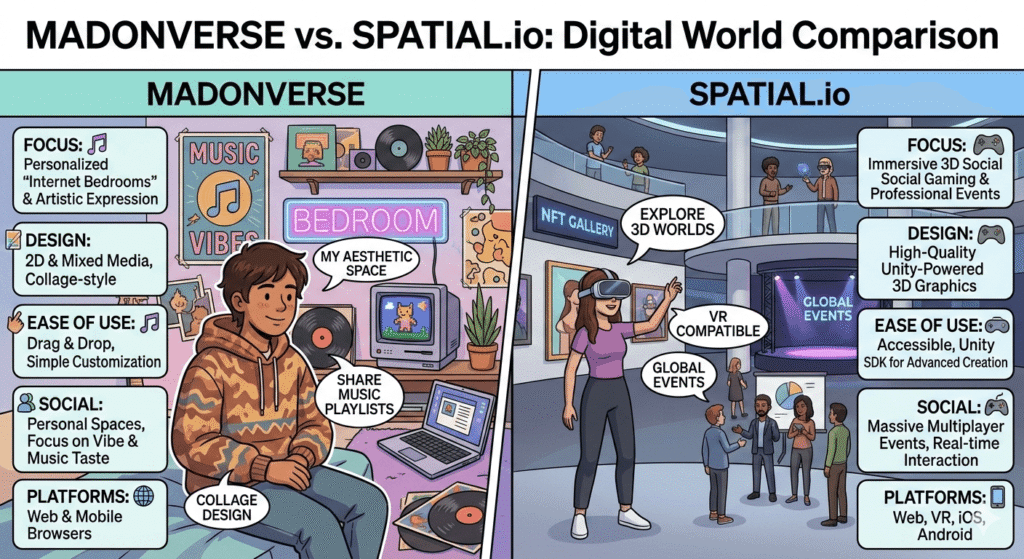
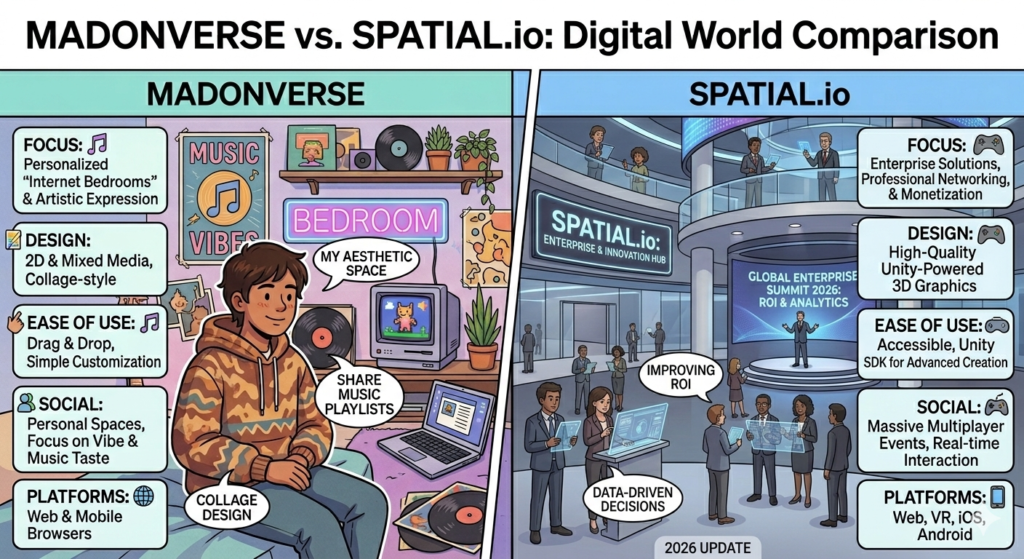
The demand for professional virtual spaces has grown rapidly as businesses, creators, and NFT communities move beyond basic video calls into immersive digital environments. Two platforms gaining attention in this space are Madonverse and Spatial. But which one is better for virtual offices, NFT galleries, and professional collaboration? In this detailed comparison, we break down Madonverse vs. Spatial in terms of features, scalability, NFT support, customisation, branding power, and long-term potential, helping you decide which platform fits your digital strategy in 2026. What Is Madonverse? Madonverse is an emerging professional-focused virtual space platform designed for businesses, event hosts, creative communities, and digital brands. It emphasizes: Unlike generic social VR platforms, Madonverse positions itself as a business-first metaverse solution, making it ideal for companies looking to build digital headquarters, host conferences, or display NFT collections in a premium setting. What Is Spatial? Spatial is a well-known metaverse platform that began as a collaborative workspace tool and later expanded into NFT galleries and virtual experiences. It allows users to: Spatial gained strong traction during the NFT boom and became popular among digital artists for hosting online exhibitions. Madonverse vs Spatial: Core Comparison Virtual Offices: Business Infrastructure Madonverse for Virtual Offices Madonverse focuses heavily on structured professional environments: It is designed for businesses that want a digital headquarters, not just a casual meeting space. Spatial for Virtual Offices Spatial supports collaborative rooms but leans more toward creative and social interaction. While businesses can use it, the experience often feels more like: Verdict:For structured corporate use, Madonverse offers stronger positioning as a professional virtual office solution. NFT Galleries: Display & Monetisation Madonverse NFT Experience Madonverse provides: It focuses on turning NFT displays into immersive branded experiences, ideal for digital artists, agencies, and Web3 brands. Spatial NFT Galleries Spatial became widely known for NFT exhibitions. Features include: It’s beginner-friendly and artist-focused. Verdict:Spatial is great for independent NFT creators.Madonverse is stronger for premium branded NFT galleries and business-level exhibitions. Customization & Branding Madoniverse Madonverse allows businesses to build a digital brand presence, not just a room. Spatial Spatial is flexible creatively, but it does not prioritize enterprise-grade branding the way Madonverse does. Winner: Madonverse (for professional branding) Accessibility & Devices Both platforms support web-based access, making them usable without expensive VR hardware. Spatial also supports multiple VR headsets, which appeals to immersive art communities. Madonverse focuses on: If your audience is corporate clients rather than VR enthusiasts, Madonverse may offer smoother onboarding. Events & Professional Use Cases Madoniverse Ideal For: Spatial Ideal For: Madonverse clearly targets enterprise and brand clients, while Spatial remains more creator-focused. SEO Perspective: Which Platform Has More Professional Positioning? From a content and positioning standpoint: If you’re building long-term brand authority around business metaverse solutions, Madonverse holds stronger niche positioning potential. Security & Control For professional environments, privacy and control matter. Madonverse emphasizes: Spatial spaces are often more open and social by design. For corporate clients, control and privacy are critical, giving Madonverse a competitive edge. Pricing & Scalability Spatial typically offers tier-based pricing for creators and businesses. Madonverse appears positioned as a customizable, scalable solution tailored to professional clients and enterprise-level needs. Businesses looking for long-term digital infrastructure may prefer a platform designed specifically around corporate scalability rather than creative exhibition hosting. Final Verdict: Madonverse vs Spatial (2026) Feature Madonverse Spatial Virtual Offices ⭐⭐⭐⭐⭐ ⭐⭐⭐ NFT Galleries ⭐⭐⭐⭐⭐ (Branded) ⭐⭐⭐⭐ (Artist-focused) Professional Branding Strong Moderate Social VR Moderate Strong Corporate Use High Medium Creative Community Growing Established Best for Professional Virtual Space: Madonverse If your goal is to create: Madonverse offers a more business-driven solution. If you are: Spatial may be a better starting point. Conclusion The future of professional digital environments is shifting beyond simple video conferencing. Businesses now want immersive spaces that reflect their brand identity and support collaboration, exhibitions, and digital commerce. In the comparison of Madonverse vs Spatial, the choice ultimately depends on your goals: For companies serious about building a structured, scalable presence in the metaverse, Madonverse stands out as the stronger long-term professional virtual space solution.
Madonverse vs AltspaceVR – The Ultimate Comparison for Virtual Events & Digital Communities (2026)
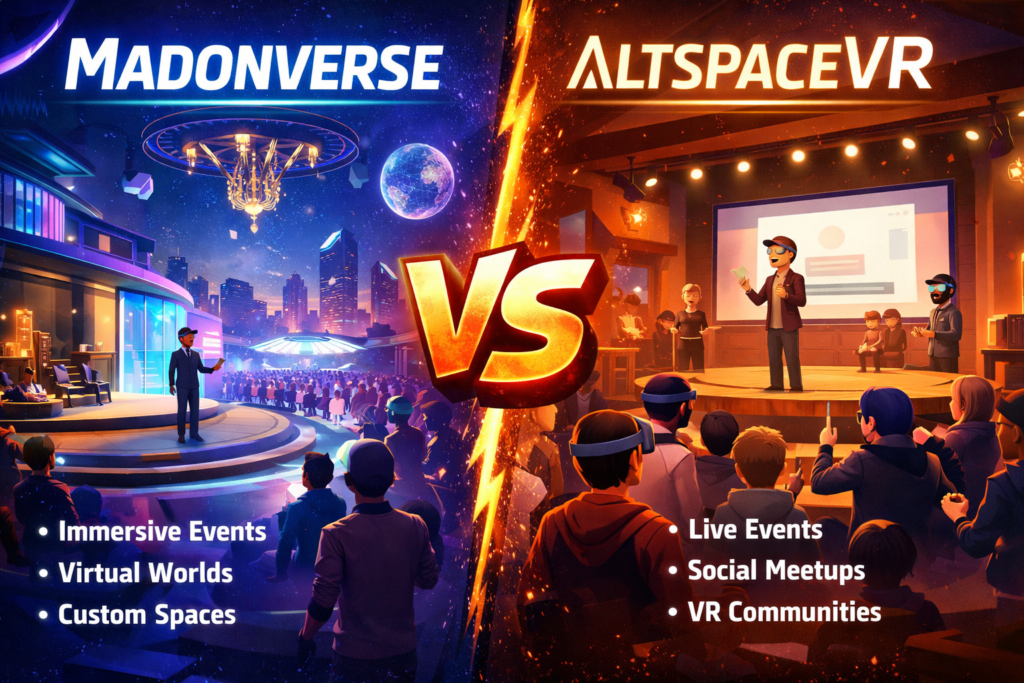
The rise of virtual events, immersive communities, and digital networking has reshaped how people connect online. From virtual conferences and live shows to interactive social gatherings, platforms are competing to deliver meaningful immersive engagement. In this strong event-focused comparison of Madonverse vs AltspaceVR, we explore how both platforms perform in hosting virtual events, supporting communities, and building interactive digital spaces. AltspaceVR was one of the earliest virtual event platforms in VR, later acquired by Microsoft. It gained recognition for hosting live shows, comedy nights, conferences, and community meetups in virtual reality. Madonverse, as an emerging immersive platform, positions itself as a structured digital environment designed for interactive engagement and potentially curated event-based experiences. Let’s break this down strategically. Features Comparison When comparing Madonverse vs AltspaceVR from an event-driven perspective, the core question is: Which platform delivers better tools for immersive digital gatherings? Event Hosting Capabilities AltspaceVR AltspaceVR built its identity around virtual events. It allowed creators to host large-scale gatherings with audience interaction. Madonverse Madonverse appears to emphasize immersive structure rather than open casual VR hosting. Event Verdict:AltspaceVR historically focused heavily on live community events. Madonverse may offer more curated immersive experiences. Community Building Tools AltspaceVR Community Strengths AltspaceVR created a strong sense of belonging among niche communities such as educators, tech groups, and artists. Madonverse Community Model If community intimacy and creative gatherings are the goal, AltspaceVR had proven event momentum. Madonverse may offer modernized immersive engagement if positioned strategically. Accessibility & Device Compatibility AltspaceVR required: Hardware requirement limited accessibility. Madonverse may: For large-scale event scalability, device flexibility plays a critical role. Avatar Interaction & Social Presence AltspaceVR excelled in: Virtual events felt alive due to avatar presence and spatial audio. Madonverse may focus on: AltspaceVR emphasized social spontaneity, while Madonverse may lean toward immersive organization. Branding & Enterprise Potential AltspaceVR hosted: Backed by Microsoft, it had enterprise credibility. Madonverse may position itself as: For businesses exploring virtual event branding, scalability and customization are key factors. Pricing Pricing determines accessibility for creators and event organizers. AltspaceVR Pricing AltspaceVR was free to join and attend events. Costs involved: The platform itself did not heavily monetize users but depended on ecosystem growth. Madonverse Pricing Madonverse pricing may vary depending on: If Madonverse adopts tiered event-hosting packages, it could appeal to professional organizers seeking structured experiences. Pricing Verdict Lower hardware barriers may give Madonverse broader audience reach. Community Size Community strength defines event vibrancy. AltspaceVR Community AltspaceVR developed: Its community was passionate and event-driven rather than purely gaming-focused. However, growth remained tied to VR adoption rates. Madonverse Community Madonverse appears to be in an expansion stage. Advantages: Challenges: Community Comparison AltspaceVR had established event-based trust. Madonverse may provide early adopter leverage and expansion potential. Who Should Use Which Platform Choosing between Madonverse vs AltspaceVR depends on your event strategy. Choose AltspaceVR If: AltspaceVR historically served creators, educators, performers, and community organizers. Choose Madonverse If: Madonverse may suit organizers seeking controlled immersive environments over open VR spontaneity. Event-Based Strategic Comparison (2026 Perspective) From a strong event-focused angle: If accessibility expands and creator tools mature, Madonverse could capture broader event audiences beyond VR-only communities. Final Verdict – Madonverse vs AltspaceVR In the comparison of Madonverse vs AltspaceVR: AltspaceVR excels in: Madonverse stands out in: If your focus is VR-native live events with established community behavior, AltspaceVR was historically a powerful platform. If your goal is to build immersive digital events with potential scalability and reduced hardware barriers, Madonverse may offer a strategic long-term opportunity. Virtual events are evolving. The next generation of digital community platforms will be defined by accessibility, scalability, and immersive quality — and both platforms reflect different stages of that journey.