The idea of owning land in a virtual world once sounded futuristic. Today, it’s a multi-million-dollar reality. Platforms like Decentraland proved that blockchain-powered virtual real estate could attract investors, NFT creators, and global brands.
But as the hype phase of the metaverse matures, a deeper question is emerging:
Is pure decentralization enough, or do businesses now need structured, professional virtual environments?
That’s where the comparison between Madonverse and Decentraland becomes interesting.
This isn’t just a platform comparison. It’s a comparison between two different philosophies of the metaverse.
The Decentralised Vision: Decentraland
Decentraland was built on Ethereum with one powerful promise: true digital ownership.
When someone buys land inside Decentraland, they don’t just rent space. They own a blockchain-based NFT parcel. Every transaction is recorded on-chain. The economy runs on its native token (MANA). Governance decisions happen through DAO voting.
For crypto-native users, this model is revolutionary.
It empowers:
- NFT traders
- Virtual real estate investors
- Web3 developers
- DAO participants
- Decentralization advocates
In bull markets, Decentraland thrives. Land prices rise. NFT exhibitions multiply. Brands experiment with virtual storefronts. Crypto enthusiasm fuels activity.
But decentralisation comes with complexity.
Users need wallets. They must understand gas fees. They navigate market volatility. For experienced crypto users, this is normal. For traditional businesses, it can feel overwhelming.
And that’s where the shift begins.
The Structured Business Approach: Madonverse
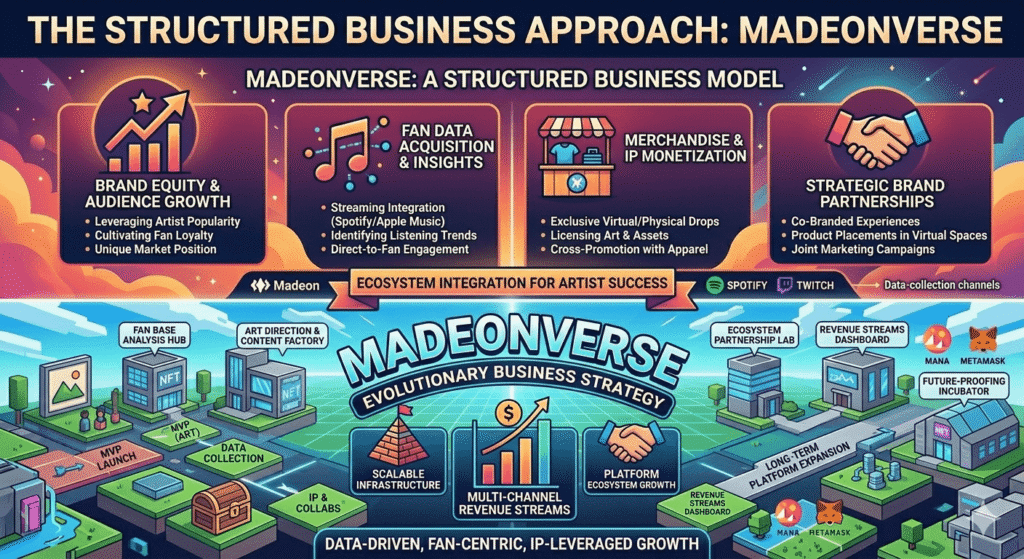
Madonverse takes a different direction.
Instead of focusing primarily on speculative land ownership, it focuses on usable professional infrastructure. The emphasis is less about tokenized plots and more about functional digital environments.
Imagine a brand wanting to launch a new NFT collection. In Decentraland, they might need to purchase land, build the experience, handle blockchain integration, and manage crypto-based transactions.
In Madonverse, the focus appears to be on ready-built, customizable virtual environments designed specifically for business purposes: virtual offices, curated NFT galleries, and controlled-access event spaces.
The difference is subtle but important.
Decentraland is ownership-first.
Madonverse is experience-first.
Crypto Investment vs Commercial Utility

If someone searches “Madonverse vs Decentraland,” the intent is often commercial.
They’re not casually browsing. They’re asking:
- Where should I invest?
- Where should my brand build presence?
- Which platform offers a stronger long-term ROI?
For crypto investors, Decentraland offers something tangible: tokenised assets. Land scarcity. Market-driven valuation. It aligns with Web3 ideology and digital property speculation.
For brands and enterprises, the question is slightly different.
They’re less interested in speculative land value and more interested in:
- Stability
- Professional presentation
- Audience engagement
- Brand control
- Ease of deployment
That’s where Madonverse positions itself differently.
It reduces friction. It simplifies onboarding. It prioritizes brand environment over blockchain complexity.
Market Cycles and Risk Exposure
One critical difference between these platforms is their exposure to crypto volatility.
Decentraland’s activity is closely tied to the broader crypto market. During bullish cycles, engagement spikes. During downturns, activity can slow dramatically.
Its value ecosystem is deeply integrated with Ethereum performance and NFT demand.
Madonverse, by focusing more on business utility rather than speculative land economics, may be less dependent on crypto hype cycles. Its growth potential appears tied more to corporate digital transformation than token price movements.
For investors seeking high-risk, high-reward exposure, Decentraland aligns well.
For companies seeking steady digital infrastructure, Madonverse may offer more predictable positioning.
Governance vs Brand Control
Another fundamental difference lies in governance.
Decentraland operates through decentralized governance. Community members vote on platform decisions. While this empowers users, it also means brands operate inside a community-driven ecosystem.
Madonverse appears more centrally structured, which allows:
- Stronger brand safety
- Moderated environments
- Controlled access spaces
- Structured business standards
For corporate adoption, control often outweighs decentralization philosophy.
Which One Aligns With 2026 Metaverse Trends?
The metaverse narrative is evolving.
The first wave was about decentralization and ownership.
The second wave is about monetization and commercial application.
Businesses are no longer experimenting just for hype. They want measurable outcomes. They want immersive spaces that drive engagement, lead generation, and digital product launches.
In that context:
Decentraland remains powerful for:
- Crypto investors
- NFT-native communities
- Web3 developers
- Digital asset traders
Madonverse appears better aligned with:
- Corporate brands
- Virtual office adoption
- NFT exhibition launches
- Professional digital events
- Enterprise metaverse infrastructure
The Final Perspective
Madonverse vs Decentraland is not a question of which is “better.” It’s a question of which philosophy fits your objective.
If your priority is blockchain ownership, speculative virtual land, and full decentralization — Decentraland is the pure Web3 choice.
If your priority is building structured, professional, commercially viable virtual environments — Madonverse presents itself as a business-oriented alternative.
The metaverse is no longer just about owning pixels. It’s about creating digital ecosystems that generate real-world value.
And the platform you choose should reflect whether you are investing in digital property — or building digital infrastructure.